
The Supreme Court of India has stated that religious institutions must have structure and norms for their functioning, emphasising that the right to manage a religious institution does not imply an absence of order.

Nepal's Hindu groups have sought an all-party discussion on restoring Hindu-nation status within three months.

The Shri Ram Janmbhoomi Teerth Kshetra Trust has completed interviews for its first full-time CEO, focusing on professional experience, vision, and management capabilities rather than personal beliefs or practices. The selection process involved multiple rounds, culminating in face-to-face interactions with 16 top candidates.
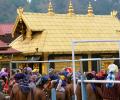
The Travancore Devaswom Board (TDB), managing the Sabarimala temple, argued in the Supreme Court that religious beliefs should be judged subjectively by the community, as the court hears petitions related to discrimination against women at religious places.

The Ram temple trust's decision to establish a permanent institute for training and certifying Hindu priests is being seen by religious leaders and members of the Indian diaspora as a significant step towards addressing the growing demand for qualified 'archaks' (priests) not only in India but also overseas.

A private school in Hyderabad has terminated a primary teacher after she assigned Islamic religious verses as homework, sparking controversy and prompting police intervention to ensure communal harmony. The incident led to protests and demands for action against the school from political and religious groups.

An FIR has been registered against a teacher and others at a private school in Hyderabad after a Hindu student was allegedly assigned "Islamic religious practices" as homework. The incident sparked outrage from political and religious groups, leading to the teacher's termination.
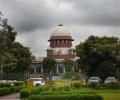
The Supreme Court has stated that roads cannot be blocked for religious activities and that while religious denominations have autonomy in worship, the government can interfere if secular activities are affected.

The Supreme Court has agreed to hear a plea on May 29 seeking a direction to the Nagpur Parsi Panchayat to treat a Parsi woman equally with her male counterparts, even after she marries a person of another faith, challenging a rule that allegedly strips Parsi women of their religious identity upon inter-faith marriage.

The BJP has accused the Congress and its INDIA bloc allies of deliberately disrupting the Monsoon Session of Parliament, alleging that their conduct has prevented discussions on key Bills and exposed the Opposition's 'double standards' on issues such as paper leaks and student protests.

The Ministry of Home Affairs informed a Joint Committee of Parliament that the number of active NGOs registered under the Foreign Contribution (Regulation) Act has halved over the last decade, even as foreign funds received by them have significantly increased. Christian associations received the largest share of these funds in 2024-25. The report comes amidst discussions on a contentious FCRA amendment bill aimed at tighter government oversight.

Following alleged thefts at the Ram temple in Ayodhya and other incidents, prominent temples across India, including Baba Balak Nath Temple in Himachal Pradesh and Ambaji temple in Gujarat, are implementing stringent new rules for counting offerings. These measures include mandatory pocketless clothing for staff, extensive CCTV surveillance, metal detector frisking, and promoting digital payments to ensure transparency, honesty, and accountability in donation management.

The Supreme Court of India has emphasised the importance of open access to all temples and 'maths' for everyone, warning that excluding any denomination would negatively impact Hinduism and divide society. This statement was made during hearings on petitions related to discrimination against women at religious sites and the scope of religious freedom.

The Shri Ram Janmabhoomi Teerth Kshetra Trust has invited applications for the first Chief Executive Officer (CEO) of the Ram temple in Ayodhya. This new position aims to strengthen administrative and financial management following alleged embezzlement concerns. The CEO will be appointed for a three-year term, overseeing various aspects from finance to pilgrim facilities, and must be an actively practising Hindu with specific managerial experience.

The Vishva Hindu Parishad (VHP) has appealed to the United Nations to intervene on behalf of religious minorities in Pakistan and Bangladesh, citing human rights violations.

The Shri Ram Janmabhoomi Teerth Kshetra Trust has appointed a new leadership team, including retired Air Marshal Jeetendra Mishra as CEO, Ayodhya lawyer Madan Mohan Pandey as trustee, Delhi businessman Mahesh Bhagchandka as treasurer, and Dr Nirmala Yadav as the first woman trustee, to address allegations of theft and improve administration and devotee facilities.

He said that just as there are rules related to religious conduct in mosques and churches, there are also traditional rules in Hindu religious places.

A primary school in London is accused of religious discrimination after a pupil was allegedly challenged for wearing a tilak. The school denies the allegations, citing its inclusive environment and existing policy.

The Karnataka cabinet has approved eight draft bills, including those addressing hate speech, cattle slaughter, and social boycott, to be tabled in the upcoming legislative session.
The Supreme Court of India has dismissed a review petition challenging its earlier verdict that a person from a Scheduled Caste (SC) community loses their SC status upon converting to a religion other than Hinduism, Sikhism, or Buddhism, effective from the moment of conversion.

For the Jagannath Temple in Puri, the timing of Rath Yatra is a matter of scriptural injunction rather than convenience.

Lucknow police are searching for a 21-year-old woman whose father filed an FIR alleging she was forcibly taken away by an acquaintance. While the father initially mentioned conversion, police clarified that the complaint does not include religious conversion allegations, dismissing social media rumours.
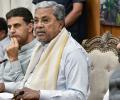
Karnataka Chief Minister Siddaramaiah has clarified that saffron shawls are not permitted in educational institutions, while existing practices such as hijab, turbans, rudraksha beads, and sacred threads will continue to be allowed.

'...appearing culturally coercive or administratively vindictive.' 'If it governs as a conquering force, resistance will build.'

'This is a major rupture in Tamil Nadu's political order.' 'For the Dravidian parties, the message is clear: The old DMK-AIADMK binary is no longer guaranteed a future.'

According to the recommendations, reviewed by Business Standard, any dress code shall always be akin to Hindu culture.

'A genuine tribute to Dr Ambedkar does not lie in selective invocation. It lies in asking a harder question: Is the Constitution still doing its job -- restraining even assertive majorities?' asks Manoj Mohanka.

A controversy has erupted in Bengaluru after five Brahmin students were allegedly forced to remove their sacred thread at Krupanidhi College during the Common Entrance Test (CET). Students claim invigilators demanded the removal of the sacred thread despite previous government assurances that it would not be required.
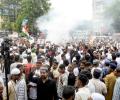
Congress MP Mohammad Jawed and AIMIM president Asaduddin Owaisi have challenged the validity of the Waqf (Amendment) Bill, 2025 in the Supreme Court, arguing that it violates constitutional provisions. The petitions claim the bill imposes arbitrary restrictions on Waqf properties and their management, undermining the religious autonomy of the Muslim community. They also allege that the bill discriminates against Muslims by imposing restrictions not present in the governance of other religious endowments. The bill was passed in the Rajya Sabha and Lok Sabha, with the petitioners arguing that it introduces limitations on the creation of Waqfs based on the duration of one's religious practice, mandates inclusion of non-Muslim members in Waqf administrative bodies, and shifts key administrative functions to government officials, thereby diluting the autonomy of Waqf management.

Hopefully, the BJP will realise that it's the right time for parivartan (change) in its polarising poll strategies after achieving the impossible-looking goal of winning West Bengal, argues Sheela Bhatt.

The Supreme Court expressed its disapproval of an analogy used by the Centre in support of the inclusion of non-Muslims in Waqf boards, stating that such logic would disqualify a bench of Hindu judges from hearing matters related to Waqf. The CJI questioned the Centre's stance on the provisions of the Waqf (Amendment) Act, 2025, which allows non-Muslim members in the Central Waqf Council and state waqf boards. The Solicitor General defended the provisions, emphasizing that the non-Muslim inclusion is limited and does not impact the Muslim composition of these bodies. However, the CJI asserted that judges shed their religious affiliations while serving on the bench and maintained their secularity in their judicial capacity.

'Shivakumar's relationship with the BJP and the RSS is not adversarial in the way Siddaramaiah's has been.' 'Siddaramaiah has publicly attacked the RSS on record; Shivakumar has made no such statement at any point.' 'He vociferously defended the Karnataka government's celebration of Ram temple consecration with RSS-ish arguments.'

Political observers said the announcement assumes significance as the state prepares for the assembly elections, with political parties stepping up outreach to various community groups.

'...especially pressure on the rupee, the current account deficit, and foreign exchange outflows.' 'The key question over the next several months is whether the government can prevent external turbulence from feeding into domestic economic pessimism.'

Tensions between Shankaracharya Swami Avimukteshwaranand Saraswati and the Uttar Pradesh government led by Chief Minister Yogi Adityanath have drawn national attention in recent months.
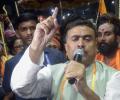
Protests continue in Kolkata against attacks on minority Hindus in Bangladesh. BJP leader Suvendu Adhikari threatens a large-scale protest if the attacks are not stopped.

'The state government does not believe in disallowing non-Hindus to do business outside Hindu temples.'

'I cannot imagine that any NSA before Ajit Doval would have given us this kind of time and this kind of engagement. They would have offered slogans, or nothing at all. That, too, tells you something.'

Seeking clarification, Karnataka Governor has sent back to the government a bill that sought to collect funds from temples with over Rs 10 lakh annual income, citing that a case concerning the earlier related act and amendments made to it is still pending in Supreme Court.

The apex court also issued notice on the interim relief sought in the plea for restraining the state from appointing or dismissing 'archakas' (priests) at temples and Hindu religious institutions in the state till the disposal of the petition.
